Showing posts with label separation agreement qld. Show all posts

Wednesday, 13 April 2022

Spousal Maintenance | Spousal Maintenance qld


Aylward Game Solicitors Family Law are Australian Family Lawyers located in Brisbane.

Spousal maintenance is a responsibility you or your ex-partner might have to financially support the other person after separation or divorce. In Queensland, de facto partners may have no right to maintenance if they separated before March 1, 2009. This is not the case if you separated after this date. Your future needs can be considered when the property is divided. In most cases, the courts require that you endeavor to resolve disputes outside of court. We can assist with dispute resolution services. If you cannot agree, you can apply to the court for a financial order.

Protect your immediate financial needs and your financial future

Under the Family Law Act in Australia, both spouses have a duty to support and maintain each other, even after you have separated or divorced. Essentially, the laws are written such that the extent of the support depends on the following:

One spouse (the applicant) is unable to adequately meet his or her own reasonable needs; and
The other spouse (the respondent) has the capacity to pay.
When deciding any financial disputes after a divorce proceeding, the Court bases its decisions on the general principles set out in Sections 79(4) and 75(2) of the Family Law Act 1975. In summary, the judicial officer hearing the matter will try to decide on what is most fair and equitable, based on the following information (for both spouses):

Your property, financial resources, income and debts
Whether the children live with you or your former spouse
Your age and health (which determines future requirements)
Your ability to earn, and whether this has been affected by the marriage
What is considered to be a suitable standard of living?
It is necessary that both parties attempt to reach an agreement outside of court, before filing an application for spousal maintenance orders.

When spousal maintenance applications are filed with either the Family Court or the Federal Circuit Court (Federal Magistrates Court), both parties are ordered to undergo “pre-action procedures” including participation in a dispute resolution.

Family Law are Australian Family Lawyers located in Brisbane, specialising in many area of Family Law, including Spousal Maintenance.

Spousal maintenance is not automatically granted, and often is considered as part of an overall settlement of financial matters.

In rare cases, such as situations involving child abuse, urgency, family violence or fraud, the Court may accept that it is not possible or appropriate for the pre-action procedures to be carried out.

Applications for spousal maintenance must be lodged within 12 months of a divorce becoming final. Later applications require special permission from the court, but this is not always granted. Always seek advice to know your legal options.

People who found this page also searched for

  • Spousal Maintenance Lawyer
  • Pre Action Procedures
  • Dispute Resolution Services

Article Source: Spousal Maintenance  

Wednesday, 16 June 2021

PRENUPTIAL OR BINDING FINANCIAL AGREEMENTS


Prenuptial and Postnuptial Agreements and information relating to Pre Nups & Financial Agreements in Brisbane.
Prenuptial agreements and binding financial agreements will set out exactly how all or any of the assets, (owned by you at the date of signing the agreement or acquired after signing the agreement), will be divided between you and your partner in the event of breakdown of the marriage or the de facto relationship. The agreement may allow for maintenance issues to be dealt with in marriages and de facto relationships, after divorce or separation.

If you are contemplating marriage or entering a de facto relationship, it is a good idea to get a lawyer to draft and execute a prenuptial agreement/financial agreement for you. You can also have a prenuptial agreement/financial agreement drawn up during your relationship. This will safeguard your personal assets in the event your relationship does not work out.

Always know your legal options by consulting an Accredited Specialist Family Lawyer in Brisbane.

PRE-NUPS, POST-NUPTIALS & BINDING FINANCIAL AGREEMENTS BRISBANE (BFA’S)

Protect your assets and your financial future before, during and after the breakdown of a relationship, partnership or marriage.

If parties in a relationship (family, de facto, same sex couples) come to an agreement on how they intend to divide their assets, then they can enter into Consent Orders or a Prenuptial Agreement/Financial Agreement to make the agreement legally binding.

CONSENT ORDERS

Parties can enter into consent orders to finalise the arrangements in relation to property, children, and spousal maintenance by signing an Application for Consent Orders document and lodging the document with the Family Court of Australia. The Application is considered by the Court and the orders made by a Judicial Officer. Parties can apply for consent orders without the necessity of going to Court.

PRENUPTIAL, POST-NUPTIAL AND BINDING FINANCIAL AGREEMENTS IN BRISBANE

A Prenuptial Agreement is an agreement entered into between parties that relate to spousal maintenance and the distribution of property. A Prenuptial Agreement is not lodged with the Court. There are several types of Prenuptial Agreements.

IF YOU WOULD LIKE TO READ THE RELEVANT SECTIONS OF THE LEGISLATION IN REGARD TO DIVORCE PROPERTY SETTLEMENT PLEASE GO TO THE FAMILY LAW ACT. PLEASE REFERENCE SECTIONS 90 & 90U.

PRENUPTIAL AGREEMENT AND FINANCIAL AGREEMENT BEFORE, DURING AND AFTER RELATIONSHIP BREAKDOWN

Parties are able to enter into a prenuptial agreement or financial agreement regarding assets acquired:

  • before and during the relationship; as well as
  • after the relationship has ended.

Note: Brisbane Prenuptial Agreements and financial agreements can be particularly useful where you have inherited assets from a family estate, or where you have accumulated your own personal wealth from a successful career and making wise investments.

To make an appointment please call us on (free call) 1800 217 217

People who found this page also searched for

  • Pre Nups Brisbane
  • Consent Orders Brisbane
  • De Facto Lawyers Brisbane

BINDING FINANCIAL AGREEMENTS

Some helpful advice if you are considering entering into a Financial Agreement.

Financial Agreements under the Family Law legislation are not simple agreements, especially for same-sex couples. There are certain requirements that must be complied with if the agreements are to be binding. If these requirements are not properly dealt with the Court will have no hesitation in overturning a Financial Agreement should either you or your partner in the future not wish to be bound by its terms.

Solicitors are required to advise the parties entering into a Financial Agreement on the advantages and disadvantages of entering into those agreements. The parties sign a certificate attached to the agreement that they have received this independent legal advice. The solicitors also sign certificates stating that they did provide the advice required prior to the parties signing the agreement.

BINDING FINANCIAL AGREEMENTSThe advice not only deals with the terms of the agreement itself but also provides full advice on the legislation under the Family Law Act and the positions the parties would be in if they had not entered into the agreement.

Agreements are drafted to suit the particular circumstances of each case. The agreements come under different sections of the Family Law Act depending on whether the parties are in a de facto relationship and wish to remain in that relationship if the parties are in a de facto relationship and intend to marry, an agreement during marriage and also an agreement after a divorce setting out the terms of a property settlement dealing with the financial issues arising from the breakdown and the divorce in the marriage

When drafting the agreement and to enable a solicitor to provide the required advice it is necessary to obtain detailed instructions of the relationship, contributions made by the parties at the commencement of the relationship, and contributions made by the parties during the relationship. Without these instructions, full and proper advice cannot be provided.

Once a client’s instructions have been obtained in regard to the relationship and contributions it is then necessary to obtain the detailed instructions in regard to the wishes of the parties in regard to assets they wish to maintain full and legal control over and those assets which are to be joint assets. Instructions are also required in regard to superannuation, estate rights and spousal maintenance should the relationship break down or if there is a death of one of the parties.

Once the agreement has been drafted setting out the parties’ joint instructions to their respective solicitors it is then necessary to provide detailed advice on the terms of the agreement reached and on the advantages and disadvantages of entering into that agreement.

Unless all these steps are carried out and proper advice given there is a strong possibility that the agreement would be overturned by the Family Court if a party upon separation wishes to set aside the agreement and seek a greater property settlement than that set out in the agreement itself.

It is necessary for both parties to provide schedules setting out their present assets, liabilities, and resources including superannuation. The updated schedules are required to be attached to the Financial Agreement itself.

It is to be hoped that the parties agree on the values of the items set out in the schedules without requiring formal valuations to be carried out. The solicitor acting for the other party is required to give the advice that has been mentioned.

WHAT ARE THE ADVANTAGES OF ENTERING INTO A POST-NUP, PRE-NUPTIAL AND FINANCIAL AGREEMENT?

  1. A financial agreement does not become a court record. There is no requirement for filing the financial agreement in any court and in particular, there is no requirement for filing a financial agreement in the Family Court.

However, it is necessary that the original agreement is given to one party and that a true copy given to the other party.  It is also necessary that the financial agreement is stored with a person’s important documentation.  The agreement does not come into effect until sometime in the future when a separation occurs and this may not be for a considerable number of years.  Therefore there is an obligation on the parties to maintain the financial agreement in case it does become relevant at some future time.

  1. The parties can incorporate spousal maintenance terms into their financial agreement. The parties may wish to define the spousal maintenance to be paid should there be a breakdown in their relationship and should the financial agreement come into force.  Although the financial interests of the parties are clearly defined in the agreement a party in certain circumstances could apply for spousal maintenance after separation even if there have been terms included in the financial agreement preventing the party from applying.

It is advisable to define clearly the spousal maintenance to be paid should a separation occur.

However, the parties should be aware of the provisions of section 90F of the Family Law Act and other provisions where there is a de facto relationship.  These provisions state:-

  1. No provision of a financial agreement excludes or limits the power of a court to make an order in relation to the maintenance of a party to a marriage or a de facto relationship if the court is satisfied that, when the agreement came into effect, the circumstances of the party were such that taking into account the terms and effect of the agreement, the party was unable to support himself or herself without an income-tested pension, allowance or benefit.
  2. The assessment of the ability of a party to support themselves without an income-tested pension benefit takes place not when the agreement is made but when it takes effect.

ABOUT CHILD MAINTENANCE AND CHILD SUPPORT

In regard to child maintenance or child support terms for child support, terms can be inserted in a financial agreement but such terms must meet the requirements of the Child Support (Assessment) Act.  Effectively a child support provision in a financial agreement can only set out on a temporary basis the child support obligations of a party to the agreement.  Once a child support assessment is made by the Child Support Agency, any child support provision in a financial agreement ceases to have an effect and is unenforceable.

  1. Provisions can be incorporated into a financial agreement to determine the superannuation interests of the parties. That is pursuant to the terms of the agreement the parties can determine how their superannuation entitlements will be paid if there is a separation of the parties and when the terms of the agreement come into effect.  However, careful consideration must be given to the drafting of terms in regard to superannuation.  A number of a person’s entitlements will only become known when the agreement comes into effect upon separation or the death of one party.  As in a court order, there can be a splitting of a person’s superannuation entitlements.  However, the drafting of such terms must satisfy the requirements of the trustee of the particular fund.  The superannuation determination will only affect the policy that is taken into account.  There may be other superannuation funds that a party enters into in subsequent years and therefore provides for these superannuation entitlements may not have been envisaged at the time that the agreement was entered into.  The agreement could take effect many years later.  Where a superannuation fund has not been specifically referred to the entitlements of a party to that fund upon death will be given to the nominated beneficiaries in the fund itself.  To ensure that a party obtains an interest in a person’s superannuation entitlements upon death then the party must be aware of the beneficiaries in his actual superannuation fund.  For the benefits in a superannuation fund to be paid to the other party upon separation,  the provisions must be specifically set out in the financial agreement and the trustee of the fund must be given procedural fairness to approve the provisions set out in the agreement.
  2. The parties in a financial agreement can limit the agreement if it is their wish to do so to name only certain assets to be dealt with upon separation. For instance, if there is a family farm and the family requires that it remain in the family and not be given to another party then provisions can be set out in the financial agreement to ensure that occurs.  As well if there is to be a partial transfer of an interest in an asset upon a separation then again the provisions can be drafted to ensure that partial separation does occur.  A financial agreement may cover the assets of the parties or can be limited to certain assets if the parties so wish.  This means that the assets falling outside of the agreement will be dealt with under the general provisions of the Family Law Act and in relation to the law applicable at the time of the separation.
  3. The financial agreement may include third parties and the third parties can be bound by the terms of the agreement. The Family Court does not have the power to make orders against third parties and therefore a financial agreement has a greater advantage over court orders in this regard.

WHAT ARE THE DISADVANTAGES OF ENTERING INTO BINDING FINANCIAL AGREEMENTS

Disadvantages of entering into a financial agreement:

  1. The parties to a financial agreement clearly define what will happen to their assets and liabilities if a separation should occur in their relationship. This separation may occur many many years after the financial agreement is entered into.  The terms of the financial agreement only come into effect once that separation occurs.  There could be substantial changes in the person’s financial positions during the years after the agreement is entered into.  Although the agreement may be fair and equitable at the time the agreement was entered into it may not be fair and equitable many years later when the terms of the agreement come into effect.  This would mean that a party may suffer severe financial hardship because the terms of the agreement are not relevant at the time the separation occurs.  There could be substantial changes in the assets and liabilities of the parties or a party could make substantial contributions towards the acquisition and improvement of assets but would gain no financial interest in the assets although the value of the assets has subsequently increased.  A party could make substantial contributions towards the acquisition and improvement of the assets but gain no interest in the increased value of such assets at a later date.
  2. The parties are required to obtain specific and detailed legal advice prior to and at the time of entering into a financial agreement. How can one party ensure that the other party obtains proper legal advice?  Even though one party does obtain the required legal advice the other party may not obtain legal advice that is sufficient and therefore the agreement can be set aside.  It is difficult to ensure that the other party does obtain the required legal advice.
  3. As stated earlier, agreements are not required to be filed or lodged with any court. If the parties lose their agreements and if the solicitors’ copies cannot be obtained then the parties will not be able to enforce the provisions of that agreement.
  4. There is a large cost in ensuring that the parties have been given the proper legal advice and in ensuring that the document has been properly drawn. Consent Orders at the time of separation are more binding than financial agreements because they are more certain.  There is always the uncertainty of entering into a financial agreement or having that agreement overturned at some later date.
  5. A party must ensure that children born after the agreement has been signed are taken into consideration. Under the terms of the Family Law legislation, a party who has the care of children could gain substantial interests in the net matrimonial assets.  However, if parties enter into an agreement and do not cater for children being born at some subsequent time then they may be financially disadvantaged after separation in their relationship.
  6. Full disclosure is required by both parties of their assets and liabilities. If at a subsequent time after the signing of the agreement or upon a separation a party becomes aware of other assets owned by the other party and not disclosed in the agreement then the agreement may be set aside.

BINDING FINANCIAL AGREEMENTS MAY BE SET ASIDE UNDER THE PROVISIONS OF THE FAMILY LAW ACT

The Family Law Act 1975 provides that a financial agreement will “end” in two circumstances.  It can be either “terminated” under s90J or 90UL or “set aside” under s90K or 90UM.  Termination is an action of the parties but setting aside is an action of the court.  A court may set aside an agreement if it is “void, voidable or unenforceable”.  If this ground is used, the parties or one of them may already consider that the agreement no longer operates.  A party may apply to the court for an order that a financial agreement is set aside in circumstances where that party already believes that the contract has been rescinded, breached or is otherwise unenforceable.

  1. Sections 90J and 90UL of the Act specifically provides that parties to a financial agreement may only terminate it by:
    1. Including a provision to that effect in another financial agreement, or
    2. Making a written agreement known as a ‘termination agreement’.
  2. Financial and termination agreements can be set aside under s90Kor 90UM:-

Tuesday, 15 June 2021

Separation And Divorce | Divorce Lawyers Brisbane

Separation And Divorce


Many couples separate and can agree on what they wish to happen in relation to a distribution of the asset pool (property settlement) and if there are children, the arrangements that they wish to put in place for the children’s future.

When couples are in agreement the options for formalising the property settlement and arrangements for the children are:

  • Consent Orders
  • Parenting Plan
  • Financial Agreement

These options are discussed in more detail under the children and financial issues sections of this booklet.

WHAT HAPPENS IF COUPLES ARE UNABLE TO AGREE ON FINANCIAL AND CHILDREN’S ISSUES?

There are a number of ways to resolve diffences after a relationship has broken down.

  1. Counselling
  2. Collaborative Practice
  3. Mediation
  4. Family Law Litigation

1. Counselling

Counsellors can help you to work through problems after the breakup. You can find qualified counsellors in private practices, as well as in government and community-based organisations.

Counselling works best if you and your partner attend sessions of your own free will. However, if you and your partner go to the Family Court, you may be ordered to attend Counselling before a decision is made by the Court.

If Counselling does not prevent your relationship from breaking down it can still help with resolving emotional issues that result from the separation. It is a good idea to shop around to find a counsellor with whom you feel comfortable and confident.

2. COLLABORATIVE PRACTICE – THE NEW ALTERNATIVE TO LITIGATION

Collaborative practice is a popular dispute resolution method developed in the United States in the early 1990s. It has gained rapid popularity in the United States, the United Kingdom, and Canada. Now Collaborative practice is available to help people in Australia

Benefits of Collaborative Practice

  • You have the benefit of being advised and supported by your lawyer at all times.
  • The outcomes are generally faster than traditional negotiation methods and most certainly quicker than court outcomes.
  • The outcomes are certain and long-lasting because they are owned by you as you assisted in creating the outcomes.
  • The process promotes co-operation in the future, particularly where long-term investments are involved.
  • Resolutions are reached in a dignified and respectful way.
  • The outcomes are often tailor-made and more creative providing fairer settlements. 

The collaborative practice may be suitable for you and your partner if both of you: 

  • Wish to spare your children from the emotional damage litigation can cause.
  • Accept personal responsibility in moving forward and reaching an agreement.
  • Believe it is important to create healthy and more holistic solutions for your future.
  • Understand and embrace the necessity to make full and frank disclosure about financial issues.

The collaborative practice may not be suitable for you and your partner if either of you:

  • Have a primary aim to seek revenge against your former spouse or partner.
  • Are looking for a “soft option”.
  • Believe the procedure will pressure your spouse or partner to agree to your wishes.
  • Want to avoid giving certain financial information to your spouse or partner.
  • Where your relationship has experienced domestic violence or any form of abuse. If this is the case, the lawyers will first have to determine whether Collaborative practice is appropriate. It may be that other professionals are required to be involved to assist and support you through the process and to ensure that your interests are promoted and protected.

Make your own decisions

The Collaborative approach will enable you and your partner to resolve your issues respectfully so that you can arrive at dignified solutions to your dispute with your partner and maintain a sound relationship with each other in the future, especially if long-term financial interests are involved. In the Collaborative practice process, emphasis is placed on reaching an agreement, rather than having to ‘battle it out in Court’.

Commitment to the non-confrontational dispute resolution

In the Collaborative practice, you will be asked to sign a Participation Agreement so that you demonstrate your commitment to resolving your differences with your partner in a respectful manner, with full and frank disclosure of information, and with a minimum of conflict. Open communication will build an environment of trust. This trust will help you, your partner, and both of your lawyers to work together in finding workable solutions to your dispute.Commitment to non-confrontational dispute resolution

In Collaborative practice, you and your partner and your lawyers will work together to share information and to arrive at solutions through a series of meetings. Your lawyer will never negotiate deals without your active participation. A major benefit of Collaborative practice is that you and your partner can each contribute to the compromised agreements that you make together, instead of having to settle with a decision imposed upon you by the Court.

Total ‘out-of-Court’ settlement with Collaborative practic 

At the commencement of the collaborative process all parties and their lawyers will enter into a Participation Agreement. Pursuant to the terms of the Participation Agreement the parties agree that they will not litigate their matter in the Family Court. This means that if either you or your partner decides to commence proceedings in Court and continue with such proceedings during the collaborative process, your collaborative lawyer will not be able to represent you in the collaborative process they will only be able to refer you to another trusted practitioner to handle your Court case.

How does it all work?

Collaborative practice is different from going to Court. You will be in a room with your lawyer as well as your partner and their lawyer. Both lawyers will be properly trained in the collaborative approach. We all work together towards the common goal of resolving the dispute between you and your partner, with emphasis on retaining your dignity and best interests.

You will have your collaborative lawyer advising and assisting you throughout the negotiations. The playing field will be more even between you and your partner, because you and your partner will have your respective lawyers to support you, as well as other professionals if necessary and with your consent.

The integrated approach of Collaborative practice

Collaborative lawyers often work with other professionals, such as accountants, financial planners, valuers, counsellors and mental health professionals, who are trained in the collaborative approach. These people will work together with your collaborative lawyers with your consent with a focus on developing an overall dispute resolution package that will provide both you and your partner with security and direction.

Note: In Collaborative practice, your lawyer and your partner’s lawyer will draft your agreement in legal terms.

3. MEDIATION

Overview of Mediation

Mediation is a voluntary process, but the Family Court may order that you and your partner participate in mediation, depending on your circumstances. Only you, your partner and the Mediator will be part of the Mediation process. Depending on the level of conflict and personal dynamics of the relationship between you and your partner two Mediators may be necessary.


Role of the Mediator
If the Family Court orders mediation or you and your partner agree, you may be allowed to have your lawyer present in the mediation. The Mediator’s role is to assist communication between you and your partner so that you can have open discussions and negotiate a settlement.

The Mediator’s aim is to facilitate open communication between you and your partner so that you can:

  • identify issues of the dispute;
  • generate options to address these issues; and
  • agree upon ways to resolve the issues (i.e. ‘settlement’).

The Mediator’s role is essentially a neutral one.  The Mediator:

  • will not take sides;
  • will work with both you and your partner to help you negotiate your own decisions together; and
  • will not represent either of you in Court either before or after the Mediation.

Characteristics of Mediation

  • All decisions in mediation will be made by you and your partner, not the Court or anyone else.
  • Mediation will help you to identify important issues that relate to your assets and finances and/or care arrangements for your children.
  • Mediation is readily accessible, making it fast and efficient.
  • Mediation is a popular form of alternative dispute resolution.

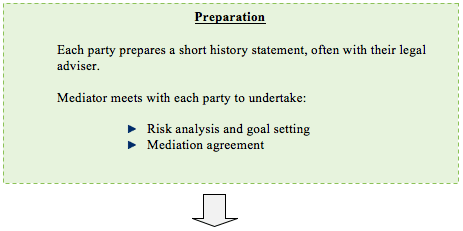
THE MEDIATION PROCESS

Separation And Divorce
  1. Fact finding and isolation of issues

At this stage the Mediator will obtain from you as much relevant information as possible, identifying the issues to be discussed and identifying any underlying conflict which may be associated with such issues. The issues will deal with such matters as property, financial assistance and the children.

Once the issues have been identified, the Mediator will then establish an agenda setting out the order in which the issues should be dealt with and which you believe would be the most appropriate way of dealing with such issues.

  1. Creation of options and alternatives

At this point, you and your partner will be looking at all the options and alternatives which could apply and which could be of assistance in resolving the issues which have been identified. By dealing with the options and alternatives, you will determine the most effective way of dealing with each issue. At this time, the Mediator will encourage you to be as creative as possible in setting up these options and alternatives.

  1. Negotiation and decision-making

At this point, you will be:

  1. Choosing options which you can best live with;
  1. Ensuring that you fully understand the details and implications of each proposal and what their consequences will be for you. This stage of the process may extend over one or two sessions. As you could imagine there will be a lot of discussion at this point in reaching agreement on those options and alternatives.
  1. Clarification of agreements reached

Hopefully, agreements will be reached on issues which have been isolated and discussed, and the Mediator will then prepare a written draft setting out your concerns, intentions, the facts agreed and decisions which have been reached. The agreement can also deal with your future dealings and relationships.

  1. Review of Process

At this point you can look at the matters that need to be made legally binding and determine the future review procedures required, if any.

  1. Implementation stage

This really speaks for itself in that the agreement is then put into practice.

What is the difference between Collaborative Practice and Mediation?

Mediation involves an independent neutral professional who facilitates discussions between the parties and helps them to reach an agreement. The Mediator does not provide legal advice to either party during the discussions.

In Collaborative practice, the lawyers provide advice to their clients and help them assess realistic options. The lawyers then support the clients through the negotiation process to reach an agreement.

Costs associated with the Collaborative Practice and Mediation

  • Initial consultation with your lawyer.
  • Assistance of the lawyer to complete a short history statement, if necessary.
  • Assistance of the lawyer to provide full disclosure of documents, if necessary.
  • Attendance by the lawyer in the Mediation session and in the Collaborative meetings.
  • Attendance by the lawyer in the Mediation, or throughout the entire collaborative process.
  • Preparation of consent documents by the lawyers.
  • Involvement of the lawyer throughout the collaborative process.

Other information relating to costs of Collaborative practice and Mediation

  • Discussions and agreement on the payment of the fee.
  • The fee may be a shared arrangement.
  • The costs of the Mediator will be agreed prior to the commencement of the process.
  • Because of the short duration for the preparation for attending on and completion of the Mediation and Collaborative practice processes, the costs are limited.

Cost of Collaborative practice Mediation compared to Litigation

Because Mediation and the Collaborative process resolve matters speedily and amicably, the financial and emotional damage normally caused by Litigation will be avoided by you, your family and your friends.

Mediation and Collaboration will also serve to minimise conflict between you and your partner, so that you can make amicable decisions regarding your finances and other personal interests. It will form a basis for your ongoing relationship with each other.

How is Collaborative practice different from traditional Court proceedings?

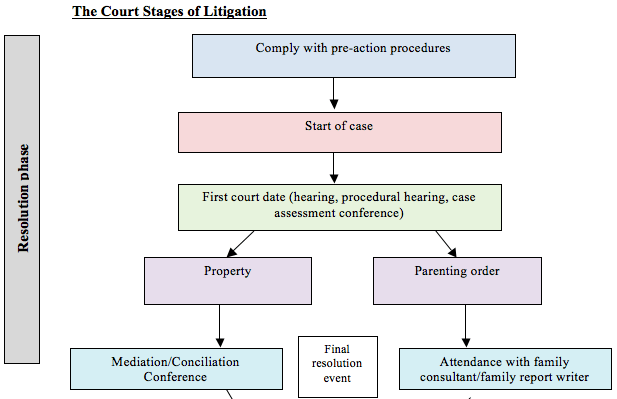
When one party commences Court proceedings they file an Application with the Court setting out the orders they want the Court to make. Both parties then go through a sequence of Court proceedings and conferences and hearings that can take many months or possibly years before they have a final trial where a Judge makes a decision as to what orders will be made.

How is Collaborative practice different from traditional Court proceedings?

Through Collaborative practice, separating couples and their lawyers work together, sometimes with other professionals such as relationship therapists, valuers, accountants and financial planners, to find out what each party wants and how that can be achieved. The Court is not involved in this process and no documents are filed with the Court whilst the negotiations are ongoing. If an agreement is reached, the parties can elect for it to be drafted as a consent order to be lodged at the Court or to be incorporated in a binding financial agreement.

Don’t be frightened to make enquiries and conduct your own research. It is better to be empowered with legal and other knowledge than to worry about problems that may not exist.
Invitation: You are welcome to arrange an obligation free 20 minute consultation with one of our qualified lawyers, to discuss your circumstances.
Efficiency of Collaborative practice and Mediation
Dispute resolution via Mediation or Collaborative practice can be arranged in a timely manner and satisfactory outcomes can be reached relatively quickly. With either method, negotiations usually take place either over a number of sessions, or during one day, depending on the complexity of the dispute. By using either Mediation or Collaborative practice settlements can usually be reached after 6 to 8 hours of negotiation. Sometimes, Collaborative practice may take longer depending on the complexity of the dispute and whether other support professionals need to be consulted.
4. Family Law Litigation
Overview
Family Law exists to deal with legal issues resulting from separation. Our principal Ian Field is an accredited Family Law Specialist. We can provide you with advice that will empower you with knowledge of your legal rights and obligations following the end of your relationship. Our advice to you can also assist you in negotiating a settlement with your partner because you will have better knowledge of how to effectively deal with your partner’s needs and requests.
Family Court of Australia

The Family Court of Australia is the final resource available to you to reach settlements on issues in dispute. The Family Court is conscious of the expense involved in resolving issues and the emotional turmoil that is normally associated with the breakdown of a relationship. The Family Court will make orders on matters requiring urgent attention.

Financial issues relating to marriages can be brought before the Family Court:

  • at any time after separation; and
  • up to 12 months (1 year) after the granting of the divorce.

Financial issues relating to de facto relationships can be brought before the Family Court within a period of 24 months (2 years) after a separation of the relationship.


the matter is urgent;
Parties who wish to make an application in relation to children’s issues (other than an Application for Consent Orders) must first participate in family dispute resolution in an attempt to resolve the care arrangements in relation to children. A party must file a mediation/counselling certificate together with their application for children’s orders unless one of the following circumstances apply:

  • one or both parties are unable to participate in family dispute resolution;
  • there has been or is a risk of family violence by one party of the parties; and
  • there is a risk of abuse of a child/children by one of the parties.

The Federal Circuit Court

The Federal Circuit Court offers a Court system parallel to the Family Court. This Court also has other federal jurisdiction, including bankruptcy. It combines its federal jurisdiction with family law matters

The purpose of the Federal Circuit Court is to provide a faster, less expensive and less complex option for litigants and also to ease the workload of the Family Court. This allows the Family Court to focus on complicated matters that require the attention of a superior Court Judge.

The use of conciliation counselling and mediation will be strongly encouraged in appropriate cases, using both community-based counselling and mediation and the Family Court services.

The Federal Circuit Court shares its jurisdiction with the Family Court and the Federal Court. The Federal Circuit Court legislation includes provisions that enable Federal Circuit to develop procedures that are simple and as efficient as possible, including power to make rules to set time limits for witnesses and to limit the length of both written and oral submissions.

Costs of Proceedings in the Family Court or the Federal Circuit Court

Normally, each party pays their own costs associated with the Court proceedings. In some instances, a party may seek a ‘Costs Order’ against the other party in their application brought before the Court.  The Courts do have discretion to award costs against the other party in certain circumstances.

Costs may be awarded where the proceedings that have been instituted are frivolous or for some other reason the party was unreasonable in opposing or bringing applications. Costs are awarded on the actual work relating to the Court proceedings and are based on the Family Court scale, at the discretion of the Court or an indemnity basis.

Fact: An overwhelming majority of cases are resolved by agreement between parties. Historically, only 4% of matters in the Family Court have required a judicial decision.


Separation And Divorce

Marriages Families and Separation factsheet

Link to the Queensland Collaborative Law website

http://qcl.org.au/

FROM OUR LINKS DROPDOWN

Feeling Stressed


Article Source: Separation And Divorce

248x150_01